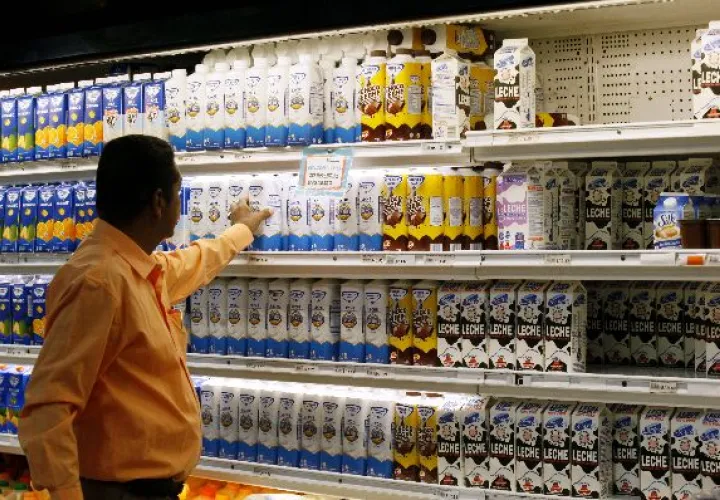
Under the guise of free supply and demand, processing of dairy products have been used to increase the price of milk 54.5% last year.
The increase has been going cautiously since last year. Liter of milk previously traded between $ 1.10 and $ 1.20 today costs the consumer to $ 1.70 in the establishments.
Producers sell a liter of milk "Grade C" between $ 0.40 and 50 cents to the processors, while the "Grade A" is sold at $ 0.54 and 60 cents with incentives. And as processors they are putting the final price.
Whenever there is an increase in the cost of dairy products it is thought that producers were increasing cost, as they have to cope with the cost of raw materials, labor and inputs.
However, Jorge Troetsch, president of the Association of Producers of Dairy Cattle Panama (Agrogalpa), noted that producers have uploaded them the price of milk once, a situation that is different from companies that have gone up consumer costs more than five times in recent years.
According to a report by the Ministry of Economy and Finance (MEF), buy dairy products, such as milk powder 360 grams, an evaporated milk 6 ounces, 1/4 gallon fresh milk and a pound of yellow cheese had a cost of $ 20.15 in 2003.
However, in 2015 purchase these same products cost $ 44.75, which means $24.60 more than 12 years ago.
The administrator of the Authority for Consumer Protection and Defense of Competition (Acodeco), Oscar Garcia, agreed that milk has a range between $ 1.35 the highest the lowest and $ 1.70 price, according to the monitoring they do in stores.
Garcia said that there is no reason for establishments have to sell at a certain price because the milk is not regulated, so it keeps the free market supply and demand, and the Authority will not be fined.
In meetings with the business sector in the country, Acodeco unveiled the concern of Panamanians with food prices that have not been impacted by lower oil and electricity.
"The consumer is expecting a different result, the low has been nearly a year ago, and result in food has marked the upward than downward as expected," noted the official.
Meanwhile, entrepreneurs are of the opinion that the market is the one that decides prices and that they have other elements that influence and is not just fuel.
The economist John Jované argues that these increases reflect the failure of the regulatory measure as they left out an essential product like milk.
Despite these increases, farmers say that consumption has remained stable, other products such as yogurt and cheese in the school season have increased demand.
La fuerte sequía en las provincias ha afectado a la producción de leche
De acuerdo con Jorge Troetsch, presidente de Agrogalpa, de los 225 millones de litros que se producen por año en Panamá, al final del 2016 se podría disminuir a unos 180 millones de litros debido a la sequía.
“La sequía está golpeando al sector lácteo al igual que los otros sectores, uno de los grandes problemas es que el ganado depende mucho del agua. La leche representa entre un 87% y 88% de agua”, afirmó.
Actualmente, la producción de la leche ha disminuido alrededor de un 50% en el centro del país y un 20% en la provincia de Chiriquí, donde ya hay más de seis fincas que han dejado de producir leche para entrar en el rubro de la carne, por ser menos exigente.
Los principales problemas que afectan a los ganaderos son la escasez de agua y los altos costos de la materia prima.
Se calcula que hay 6,000 productores “Grado C” y 240 productores de leche “Grado A”.