The alleged transparency in the contracting process with the State, through the recently approved reform of the public procurement Law, generated more questions than confidence among various sectors of society.
The opposition of these groups forced the President of the Republic, Juan Carlos Varela, to convene a new dialogue on the points on which there was no consensus.
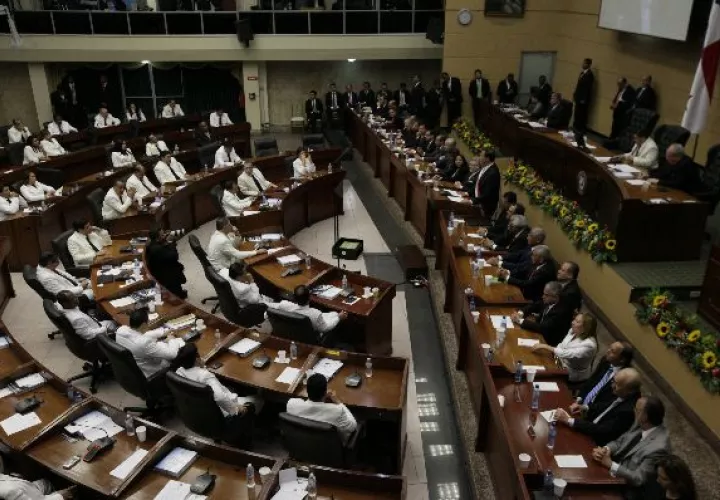
The expectation of greater transparency to which the Government referred cast doubt, after members of the civil society and the private sector questioned the speed with which the plenary of the National Assembly passed the Law, with little or no debate, according to them, responding to requirements of the executive body.
Despite criticism, to the director of procurement, Eduardo Corro, the adoption of this draft Law constituted a breakthrough in favor of transparency.
Corro said that in the nearly eight months of discussion 149 articles of the law were revised which resulted in 79 modifications and 20 new articles.
However, the complainants claim to be disappointed with Law 305 to reform Law 22 of 2006 that regulates government procurement and have asked the Executive to give a partial veto.
As a result, the President has not decided if he would partially sanction the newly approved Law or not and instead said that he is waiting for the opinion of the legal team of the Presidency of the Republic.
Varela proposes that a Law be presented only to address the matter of corruption occurring in the contracting process, which would reach the legislative plenary session on 2 July.
Lack of will
For different groups, the Government did not take the opportunity to make the necessary changes and show the world that Panama does not sponsor acts of corruption.
Issues such as the procurement of foreign companies, the big power granted to the Directorate of Public Procurement (DGCP) and the faculty to make more minor engagements, are just a few of the points that were not approved by the civil community and business associations.
Transparency International (TI) was even more direct in saying that while the Law eliminates "some of the abuses that were used to make it much easier to divert public funds", what is being proposed is still insufficient to prevent many corrupt practices from occurring that will surely "persist", if the system is not further strengthened and greater transparency mechanisms are established.
This Agency also warned in their statement, that the increase of contracts of less than 30 thousand to 50 thousand dollars requires a counterpart of control to avoid furthering corruption.
For his part, Julio De La Lastra, President of the National Council of the Private Enterprise (Conep), recalled that after the general State budget Law, the public procurement law is the second most important.
De La Lastra worries that the minor engagements model can even allow to benefit enterprises through fractional purchases.
He said that "the problem occurs with the subject of minor contracts, because then the division of matter happens, which is why little by little we come into a world of contracts".
“Let´s not fool ourselves. If I have half a million in a tender and divided it into smaller purchases or split purchases, I will get the 500 thousand dollars, but I would do in such a way that it is not very evident", he said.
He stressed that we must already get over that experience and show the world that we are seeking accountability and transparency in all our processes.
Law 22 of 2006 establishes minor contracts to the 30 thousand dollars, however, the amendment to the Law sets a maximum of 50 thousand dollars.
The businessman indicated that the idea is to have a dynamic law which does not paralyze the execution of the Government budget, but that is at the same time very transparent and avoids corruption once for all and more scrutiny on this issue of minor contracts should be sought.
Experts also added that the fractionation of purchases could create a bridge to corruption.
"When one gets to purchase in large amounts one is in a better position to negotiate for more affordable prices; When one buys in small volumes, one buys at higher prices, thus this limits this possibility", said economist Juan Jované.
For his part, Roberto Troncoso, former President of the Panamanian Association of Business Executives (Apede), said that there are several articles that were not very clear in the Law.
"I think that the time was important and the political pressure had more relevance to the context of the law," he said.
He assumes that it was approved because time was against them and they had to make a law so as to claim they did something in their government.
Article 41 sets the parameters on minor contracts and indicates that the procedure for smaller contracting will allow, expeditiously, the acquisition of goods, services or works that do not exceed $50 thousand complying with a minimum number of formalities in conformity with the principles of contracting.
Another questionable aspect of the reform is the power given to the Directorate-General of Public Revenue (DGIP).
In this regard, lawyer Ernesto Cedeño announced that he will file a complaint against this draft law, since it grants too much power to the DGCP, and bestows it the rank of both a judge and defendant, among other points.
The new project separates the disqualification of the fine that goes from 1% to 15% from the contract and establishes debarment to suppliers from three months to five years, and definitive disqualification to those who have been convicted of corruption or offences against the public administration.
Meanwhile, Angélica Maytín, Director General of the Authority of Transparency and Access to Information (Antai), has expressed dissatisfaction with this approval, since the entity presented a proposal which included sanctioning corrupt companies and asked the Executive to veto the Law.
Meanwhile, Anneth Planell, Independent Movement (Movin), indicated that they lacked political will because they had more than 8 months in which representatives of the Ministry of Economy, the Comptroller General and private enterprise representative participated and obtained a more complete draft law that was presented to the National Assembly.
However, she said that the Government ignored these notes and contributions from various civil society organizations.
-----------------
Regulation reduces the competition
The reduction in competition, which involves some parts of Law 305, which will amend Law 22 of 2006, governing public procurement, worries economists.
For Economist Juan Jované, well done public procurement reduces costs, however, when doors are opened, as in the reform of the law of contracts, what is done is to reduce competition among bidders, making the State to obtain goods and services at higher prices.
Jované warned that "everything that involves less competition and is more time-consuming for the State which will result in fewer contracts".
He recalled that in all parts of the law, including the issue of splitting, make purchases more expensive for the State, and the use of resources becomes less effective.
Economist Augusto García holds the same view and says that the public procurement law is very important for the country in many ways and this must comply with some fundamental principles.
He said that it should promote the best interest for the State, so that it can acquire goods and services and invest obtaining the greatest possible benefit of that investment.
He added that another fundamental aspect is the principle of transparency at public events, to generate confidence in investors, mostly foreign, which in turn drives the growth of the economy.
During the 2015, Panama strengthened its capacity to attract foreign investment, reaching balances in the order of $ 5,038, 17% more than in 2014.
According to the latest fiscal framework of medium-term introduced by the Ministry of economy and finance (MEF), expected a growth of 6.3% of the Panamanian economy in 2016.
Garcia said that the gaps that may have public procurement law can do that important and serious companies refrain from participating, which makes the more onerous processes for the State by the low level of competition.


"Transparency, since this aspect, should be considered as such and must not be subject to doubt, and neither conform to the extent of what needs to shift management", said.
The Economist added that compliance with these principles is essential so that the results of the investment processes are not impacted by unnecessary fees or inflated by private investors.
Garcia noted that the opposite would be a bad sign and the distrust of investors increase more the process of slowdown in the main economic activities of the country that has been affected by factors both internal and external.