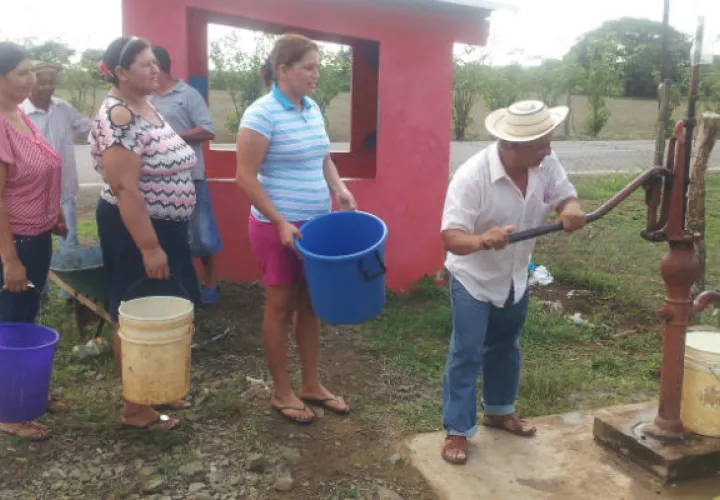
Universal access to drinking water, as well as the elimination of open-air sewers, were two of the main pillars of the electoral campaign of President Juan Carlos Varela.
However, two years into his mandate, the Varela administration has been unable to address the recurrent lack of drinking water across the country. High-ranking figures in the government have now started openly to doubt the government's ability to reach their 'Basic Sanitation' promise: 100% drinking water and an end to open-air sewers.
From the very beginning, the government announced a multimillion-dollar strategy of investments into the National Institute of Aqueducts and Sewage (Idaan), as well as the National Council of Sustainable Development (Conades). 'In the past, investment in the Idaan has been insufficient and therefore we are planning a level of investment that will be substantially greater", announced at the time Carlos Dubois, secretary of Metas.
As a matter of fact, the government is investing $1.9 billion in new water treatment facilities, improved water pipes and sewage systems. 'And yet in practice this investment has yet to produce tangible results', said Enrique Montenegro, of the national Anti-Corruption Front: 'people keep complaining of a recurrent lack of drinking water, and what you see are questionable projects', he denounced.
Mr. Montenegro pointed the finger to shady business interests in water purification facilities, which have already set alarms ringing among the population.
Former Idaan director Juan Antonio Ducreaux declared himself in favour of the current five-year investment plan, but added that the former needs to be supported by both operational improvements and commercial optimization at the public institution.
Instead of concrete measures, the Varela administration keeps referring to a "strategic plan" that has yet to be spelt out.
'Big-budget investments will serve no purpose unless Idaan itself is transformed into a public utility which is managed commercially efficiently', explained Mr. Ducreaux.
For a start, it is crucial that the institution should promote a rational consumption of water in each and every household across the country. For that purpose, Idaan will need metering facilities and a tariff structure that promotes water savings.
This is in sharp contrast to the current situation. Examples of inordinate squandering of drinking water, especially in high-income districts of the country, are all too abundant.
The numbers speak for themselves: Idaan loses an alarming $60m per year, due to water wastage caused by leaks in the system, as well as by fraudulent clients that fail to pay their dues.
In turn, water leaks cause a reduction in water pressure which condemns households in low-pressure area to persistent outages in their domestic water supply.
'And what does the government do with respect to this?'asked Mr. Ducreaux rhetorically: 'they keep talking about their famed strategic plan, which with 30 months to go before their mandate is up has
not even been announced yet'
According to the former Idaan director, the government could still have one last chance to turn things round, if only it chose to face the political cost implied by the necessary remedies.
But panameñista political veteran Jorge Gamboa Arosemena is less sanguine. According to Mr. Arosemena, the Varela administration has lacked both the courage and the capacity to take necessary measures needed to find concrete solutions to the water crisis.
Pointing out that about 30% of Idaan workers are above pensionable age and "therefore work less effectively then they should", Mr. Arosemena laid the blame squarely at the 'Idaan administrators who have failed in their duty".
He accused the institution of being trapped "in a rotten system dominated by nepotism, patronage and traffic of influence".
According to the veteran politician, the current problem has its roots in the false promises made by his fellow party members. 'I know the inner workings of my party', Mr. Arosemena declared: 'when they promised basic sanitation for everybody, they did it with patronage in mind”. He went on to add: 'you only need to look at the behavior of the panameñista parliamentary party to understand it is all about traffic of influence'. In truth, the panameñista politician did cast a doubt over the government's ability to actually deliver on its promises from the moment they were announced.
Political activist Maribel Gordon agrees. "These first two years of government are more than sufficient proof that the 100/0 basic sanitation promise was one the biggest fallacies of the current administration ". She admitted to holding little hope for the next three years: “the alarmin slowness with which the government addresses social issues does not bode well”, she declared.
For her part, independent assembly member Ana Matilde Gomez urged the population to demand solutions and not just accept empty promises. 'There are many complaints against Idaan: that is why the National Assembly unanimously called upon director Julia Guardia to provide explanations', she explained.
According to Ms. Gomez, the government has to come to terms with the simple fact that drinking water is a right that needs to be guaranteed.