
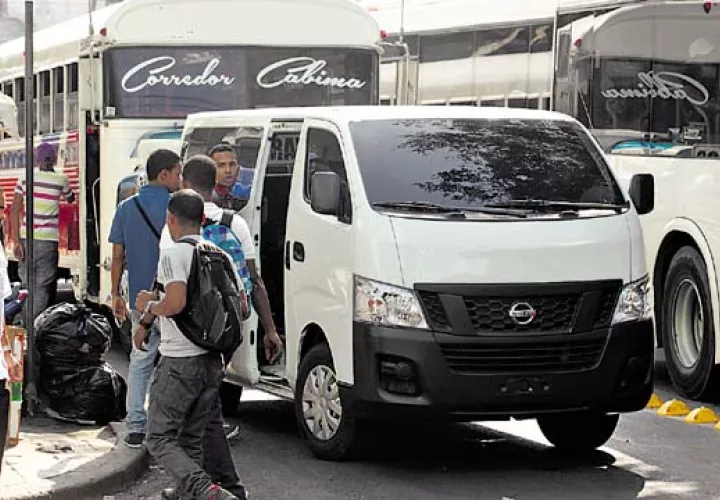
The crisis affecting the public transport system has led to the creation of a mafia controlled by people with links to the current government. Legitimate transport providers and representatives of consumer groups have denounced the arrival of new providers of pirate transport services, who have alleged links with the current administration.
The system has become so corrupt that the very people who are supposed to ensure that service providers comply with the law, are the actual operators of pirate transport services.
In an online conversation hosted on Panama America social networks, Victor Martinez, a lawyer representing transport users, denounced that "public transport has fallen into the hands of a mafia, likely made up by former officials of the Authority for Road Transit and Transport (ATTT), who
operate in connivance with current officials".
Mr. Martinez also criticized the current operations of the ATTT, where allegedly 'the director will not speak to the deputy director" and where "the government exercises undue influence, at the expense
of transport users'.
As a way of example of the current rot at the heart of the system, Mr. Martinez made reference to the declarations made by one of the nephews of Venezuela's president Nicolas Maduro, who is currently under arrest in the United States for alleged drug trafficking. 'He confessed to the U.S. drug enforcement agency (DEA) that he had acquired 20 taxi permits in Panama, which yielded $800 per
week each', Mr. Martinez related, adding that " this is proof of how all sorts of shady and questionable people have their fingers in the transport pie, at the detriment of commuters and transport users'.
Transport mafia
Mr. Martinez recalled how on October 27 2006, the former director of the ATTT, Carlos Harris, publicly declared that he had been "removed from his position by the transport mafia in connivance with insurance providers". Mr. Harris publicly denounced that "public transport was controlled on the one hand by the National Assembly exercising its influence via the Transport Commission, which in turn was itself presided over by a former transport executives turned assembly members".
Mr. Martinez also argued that a few months ago (four), 'some 300 pirate buses entered operations, carrying no registration plate and acting with complete impunity, and charging as much as $5 per ride'. “I've publicly stated to the president that the situation requires an urgent inventory to be carried out, and qualified specialists to carry it out. There are already 25 to 30 transport users that have been victims of transport accidents on metrobuses', he concluded.
On this very matter, transport executive Rafael Reyes explain that " if once there used to be some recognition of transport users’ rights on the part of transport providers, today that is gone, and the government has shown it has no political will to fix the problem".
Mr. Reyes pointed out how there are laws that exists to ensure transport services are properly regulated, but they are overlooked at the expense of quality of service. Additionally, more often than not 'the profits this business generates leave the country'.
According to Mr. Reyes, at present there is no oversight of public transport providers and the population is being taken for ride. Promises of better service, greater security, more time available to spend with one's family all ring very hollow.
He echoed the view that transport has become the victim of political bargaining: in order to comply with the demands of its sympathizers, the government has been dispensing transport permits. In the process, it has lost control of whose hands those operating permits have fallen into.
He added that the administration has gone as far as to try and change the name of pirate transport providers to "alternative buses", in a lame attempt at validating the illegal service they provide.
In his view, this situation has severely affected transport security and damaged users’ confidence in the system. 'Some drivers turn up in flip flops and shorts, which is hardly professional, and inspectors to nothing about it', he denounced.
Meanwhile, the taxi business, which should by law pertaining to Panamanian nationals only, is in fact filled with foreigners. In 2014, 42,000 permits were issued with virtually no control. At present, 1000 of those are subject to restrictions due to irregularities.
For his part, Luis Torres lamented how in certain neighborhoods such as La Cabima, pirate transport providers have increased fares to as high as $5 per ride. They tell you 'if you don't want to pay you
can get', he reported.
Mr. Torres believes that the current director of the ATTT must be acting in connivance with pirate transport providers. He urged the 'President to name someone who can actually face the pirate providers down'.
ATTT has lost control over taxi permits
The very people in charge of the Authority for Road Transit and Transport (ATTT) have recognized the existence of a "black market" in taxi permits.
The ATTT has lost control of the current situation, in which permits are issued to foreigners and companies are being set up and allowed to operate illegally without any supervision.
In an interview to TV channel TVN, the current legal counsel to the ATTT, Ulises Calvo, explained that the institution is no longer in control of the network that distributes taxi permits. Service providers have taken charge of that directly. The ATTT issues permits to companies that are in compliance with the rules: however, licensed providers then go on to transfer them to unlicensed third parties, something which is against the law.
Mr. Calvo explained that there is no legal basis to stop Panamanian applicants who represents legally constituted companies from soliciting permits. He estimated that taxi drivers pay as much as $40 per day to the providers they receive permits from.




The bill of law of 28 July, 1999, which created the Authority for Road Transit and Transport, also stipulated that licensed service providers should be entitled to offer public transport services. The law permitted such service providers to issue individual permits, based on feasibility studies carried out by the ATTT. However, once the permits are handed over to third parties, the ATTT has no effective way to supervise the market.
As a result, the price of permit varies considerably according to districts, the size of businesses and even their political affiliation. A permit can be worth between $600 and $1000.
In a clear example of how politicians have a vested interest in protecting the system, the current Secretary of the National Assembly, Franz Wever, also represents the National Federation of Taxi Drivers (Fenacota). Mr. Wever defended the status quo has being "driven by supply and demand'.
Contenido patrocinado




Últimas noticias