The lack of government policies and incentives, and the weather phenomenon El Niño, have contributed to the weakening of domestic productive sectors of the economy, mainly in the agricultural, livestock and fisheries.
So entrepreneurs and economists conclude, after estimated gross domestic product (GDP) figures reflect minimal growth of 0.4%.
This reflects, according to the president of the Agricultural Commission of the Panamanian Association of Business Executives (APEDA), Lenin Lorenzo Galvan, lack of "clear rules" aimed at domestic producers.
Galvan said that the uncertainty generated by the lack of markets makes farmers planted fewer hectares.
With this agrees economist Maribel Gordón, who says that in the country, policies are aimed at encouraging imports to the detriment of domestic production.
Meanwhile, economist Olmedo Estrada believes that the benefits achieved Panama as a hub of international cargo also drive the abandonment of agriculture and manufacturing.
According to official figures, with the exception of rice, which increased by 3.5% in 2015, and some agricultural export products such as bananas and melons by 4.7% and 17.9%, respectively, production in the primary sector showed a significant decrease.
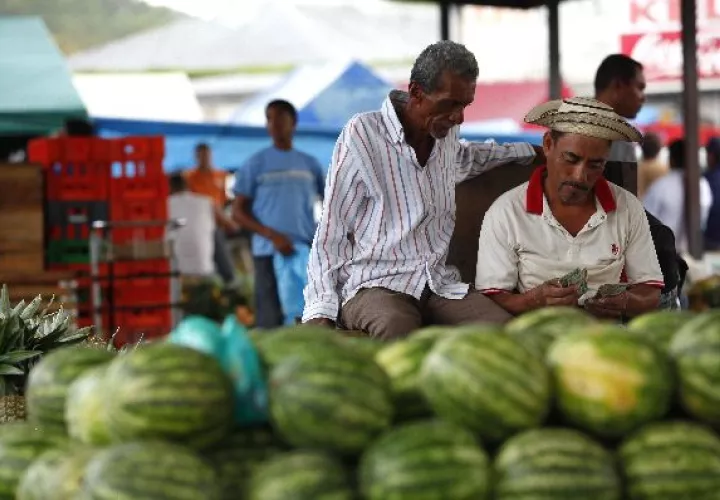
Meanwhile, the growth of agricultural activity was slowed by negative behavior in the production of watermelon and pineapple, which decreased by 9.5% and 31.4%, with reference to export.
Livestock production improved by 3%, supported by the slaughter of poultry and pork, but not in the slaughter of cattle and milk production, which fell 2.8% and 1.8%.
The latter activity presents huge losses because of drought in the region of the Arco Seco.
For Estrada, ignoring the effects of El Nino took producers by surprise, which was reflected in losses, a factor that also affects the little progress of this sector.
Another affected by El Niño activity is fishing, which decreased by 4.3% due to declining catch fish and other marine species.
Fishermen estimate a decrease of over 60% in earnings per artisanal fisheries because of the havoc it is causing El Niño.
The Inter-American Institute for Cooperation on Agriculture (IICA) adds that the evolution of productivity per worker in agriculture and per hectare has stalled and begins to be regressive.
Similarly, manufacturing during 2015 decreased by 1.3% in gross value added compared to the previous year.
Although both economists and entrepreneurs agree that the Panamanian economy is not based on the primary sector, warn of the consequences that can lead to the abandonment of its various activities.
Estrada argues that the situation facing the primary sector of the national economy is doing a country increasingly dependent on imports, a situation that also affects the price to consumers.
Estrada argues that the government should promote food sovereignty and not try to rely forever on the products offered by other countries.
"We can not abandon the production of consumer goods, such as agriculture, by cheap imports because at the time that those countries that lack products, we will be in dire need of not being able to consume," he concludes.
Studies of the Inter-American Institute for Cooperation on Agriculture (IICA) also indicate that while the signing of free trade agreements (FTA) agreements and agreements of the last 15 years has allowed most countries to increase between 200% and 300% exports in Panama has reduced.
To this, according to Gerardo Escudero, IICA representative in Panama, is attributed to the food deficit in food trade balance has soared in excess of what amounts generated annually Canal.
In 2015, the CIF value of imports of goods totaled $ 12 000 136 000 000 104 000, about $ 11 billion 440 million 355 thousand more than the value of exports, which reached $ 695 million only 749,000.
Meanwhile, Galvan technify reiterates the need for domestic production to increase production and make it competitive.
Sector primario
4.3% disminuyó la pesca, debido al descenso de la captura de productos del mar.
0.5% cayó la actividad silvícola, con base en el comportamiento de la industria maderera.