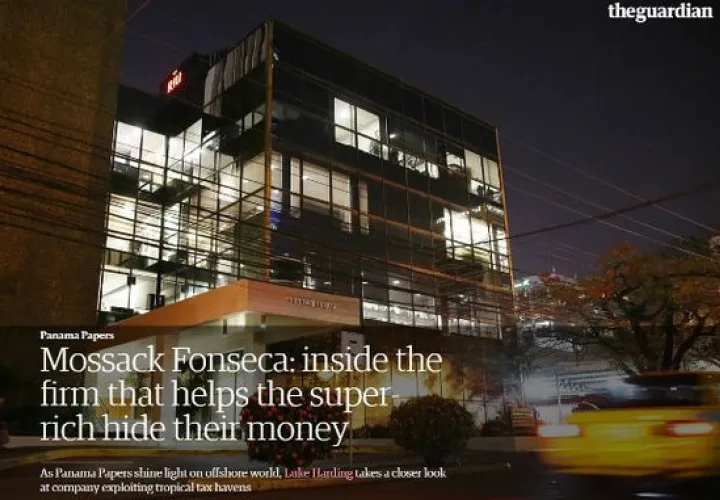
An article published by British newspaper The Guardian has unveiled how the principal partners of Panamanian law firm Mossack & Fonseca were fully aware of the final aim of clients purchasing offshore companies incorporated by their firm.
The Guardian highlights how the firm’s client list included friends of current Russian president, Vladimir Putin; the son of former president of the Arabic Republic of Egypt, Alaa Mubarak.
The newspaper also uncovered how Ian Cameron, late father of current British Prime Minister David Cameron, had set up an offshore company via Mossack & Fonseca.
Other high-profile public figures whose names were leaked include an array of African dictators, international arms dealers, drug traffickers as well as corporate vehicles belonging to pariah states such as North Korea and Siria.
Unmasked
According to The Guardian, in one 2014 email, Sandro Hangartner, head of the Zurich office of Mossack & Fonseca, “recounts a conversation with a contact who worked for Global Trust Advisors, a financial services firm based in Luxembourg. The contact told him that her Italian clients were going to desperate lengths to avoid being caught’ by the government of their country. As a solution, Mossack & Fonseca offered “a “virtual” office service for its spooked customers. For $1,500 a year, the company would set up a fake email account, using the domain @tradedirect.biz. Wealthy clients could correspond using anonymous invented names”.
Another high-profile case reported by The Guardian is that of Frederic Hottinger, “the seventh generation of a venerable Swiss banking family. The Hottingers had 11 Panamanian companies with Mossack Fonseca and were aghast when the names of these firms and their directors popped up on Google. An employee working for the Hottinger dynasty, complained. An internal email recorded:
“This [the Google search result] was too much.” The employee explained how “paranoid the Europeans are about secrecy and now they do not feel safe with offshore companies because of the level of information required””.
How does the firm operate?
The firm made recommendations to its clients on how to go about creating offshore companies in complete secrecy. The Guardian reports how Mossack & Fonseca, in 2012, “emailed a five-page PowerPoint document to a wealthy German explaining how to do it. […].The law firm recommended that the company was then restructured to show Mossack Fonseca as its beneficial owner. That way the bank would not know the German was behind the transaction”.
The publication of the so-called Panama Papers has highlighted how the internal compliance procedures of the firm proved to be frequently quite deficient. In spite of having an internal compliance department, Mossack & Fonseca seemed in reality to carry out superficial and perfunctory due diligence of their end clients’ identity and affairs, via simple google searches, and using and FBI website and online databases. “One shocking example contained in the papers shows how Mossack Fonseca incorporated three companies for Andrew Mogilyansky, a wealthy Russian-American businessman. In 2014, the firm’s compliance department belatedly found out that Mogilyansky was a convicted paedophile.”The Guardian added.

Local reactions
According to economist Francisco Bustamante, it is clear that law firm Mossack & Fonseca was aware of the background information of its own clients, as has been amply demonstrated by the torrent of documents that have been published over the current scandal. He added that any law firm has the legal and moral obligation to carry out due diligence on the risk that each client potentially represents, and that, where red flags appear, a more in-depth due diligence is always warranted.
According to Mr. Bustamante, the Panamanian executive should also reconsider its current confrontational and ineffective negotiation with France. According to another economist, Irene Jiménez, the actual impact of the unfolding scandal over the Panamanian economy will in large part be a function of how quickly and effectively the government is able to tackle it.