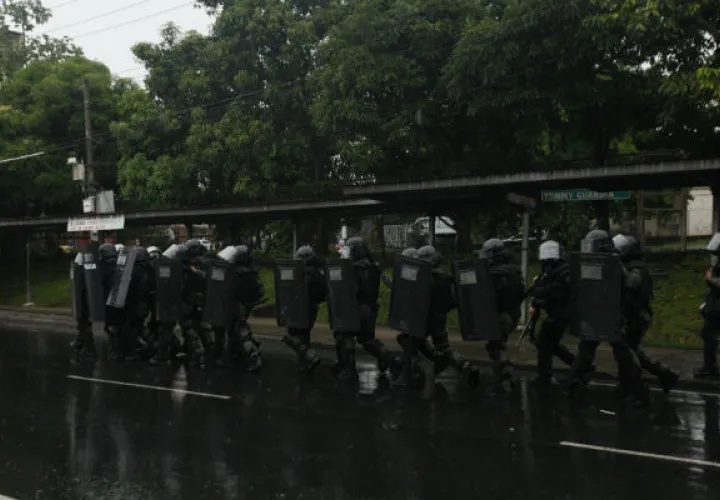
Civil society representatives have warned against a new policy of repression that the government is employing against members of the population taking part in public protests.
As the problems affecting the population across vital issues such as education, water supply and public health care have only gotten worse two years into the current administration, the government's only visible response has been via the actions of the national police force.
President of Juan Carlos Varela himself has failed to take responsibility for failing to address the needs of the population. Instead, he has attacked those daring to question the ineffectiveness of the government by calling them “spoilt brats”.
On the one hand, the president has invited civic society to make its discontents publicly known directly to ministers, who are the people in charge of addressing the issues affecting the population, and to do so on the days when government cabinet meetings occur, outside the presidential palace.
On the other, however, a number of incidents that have recently occurred between anti-protest police forces and the population, which have left many protesters injured, pointed to a less conciliatory policy on the part of the government.
The first in a series of incidents concerned supporters of the opposition party Cambio Democratico (CD). Having attempted to gather outside the Ancon police station to welcome the discharge of the party's acting president Alma Cortes, party sympathizers faced a police blockade.
The fact was denounced by Ms. Cortes, who accused President Juan Carlos Varela political persecution and of failing to solve the real problems faced by the population.
She pointed out how, instead of addressing the issue of lack of drinking water that affected some protesters in Colon, 'the government sent in the police squads". Far from having their legitimate concerns addressed, those Nueva Providencia, Colon, residents had to face police repression.
Although the Colon protests resulted in no injuries and only a few detentions, the same could not be said for protests that occurred in the indigenous region of Bocas de Toro.
There, as many as eight people suffered injuries at the hand of police squads. Faced with that toll, President Juan Carlos Varela attempted to minimize the problem by arguing that 'although no dangerous arms were employed, regrettably conflicts can and sometimes do result in injuries'.
The president went on to declare that the government would ensure that public authorities were respected and that open access to roads was maintained.
However, only last week the police had two confront a group of students of the University of Panama (UP). The students'; protest caused the shutdown of the Inter-American highway for a number of days, as well as the suspension of classes at the institution.
According to former police director Rolando Mirones, it is crucial that the government strikes the correct balance between the rights of people to protest, and the safeguard of third parties, and that it ensures that that is done in the most humane way possible.
“The police have to be professional and ensure that the safety of protesters is safeguarded, without resorting to unnecessary repression", he declared.
He also argued that "any order to repress protesters puts the police force in an unfair and difficult situation, since it's ultimately not up to them to solve the core issues'.
Warning that that repression never solved any problem, Mr. Mirones did concede that police intervention was sometimes inevitable. However, he did add that "if this government presumes to solve problems by resorting to repression, it's going down the wrong path".
According to trade unionist Fernando Cebamanos, governments tend to resort to repressive measures as their popularity falls. “This happens as those promises regarding drinking water for all, or the solution to the Barro Blanco dispute, look increasingly empty, highlighting the government's inability to negotiate effective solutions', Mr. Cebamanos declared.
He highlighted how "the presence of military personnel in key state institutions makes a policy of repression all the more dangerous'.
On that point, economist Juan Jovane echoed these concerns by pointing out President Juan Carlos Varela's inability to solve social problems. 'The government is resorting increasingly t repression, which undermines democracy and increasingly empowers the military apparatus', he lamented.