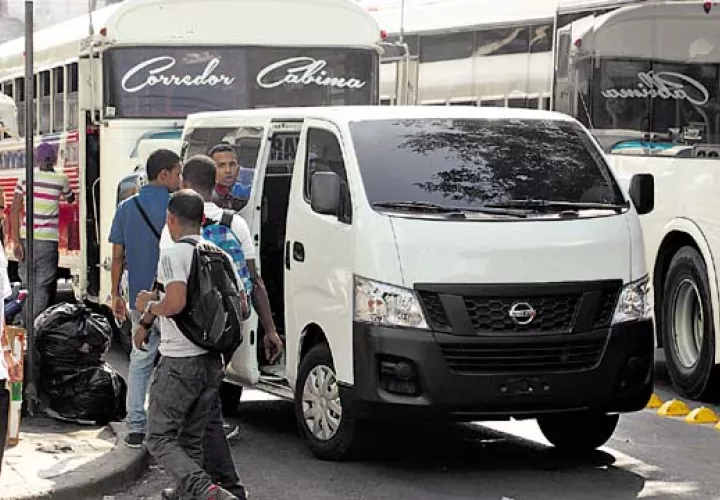
The so-called alternative means of transport, or pirate buses, have flourished under the current administration in virtue of being controlled by people with very close connections to government, not only in ministries but also at the national assembly.
These are the serious accusations that former director of road transport Carlos Harris has leveled at the Authority for Road Transit and Transport (ATTT). Mr. Harris has accused the ATTT of failing to exercise any form of control on the “alternative transport” phenomenon.
“The ATTT is running scared of the transport mafia", Mr. Harris declared, accusing'the very entity in charge of maintaining control" of being more subservient to political interests then interested in protecting the well-being and security of transport users.
An example of that were the declarations of assembly member Diogenes Vergara, who is also a transport businessman: in an intervention at the national assembly, Mr. Vergara defended pirate transport providers as offering 'an illegal but necessary service'.
It is no secret that the ATTT T is been run from the National Assembly, under the direction of assembly member for Veraguas Carlos Santana. Mr. Santana allegedly recommended that President Juan Carlos Varela name his godson, Julio Gonzales, has ATTT director.
Although Mr. Harris recognizes that politicians have historically had their fingers in the transport pie, he denounced that Mr. Santana has taken institutional corruption to new levels.
“Today we are facing a new situation: in return for providing transport services to the president during his election campaign, Mr. Santana has been given control of the ATTT", Mr. Harris explained.
He went on to accuse the government of relinquishing their responsibility towards transport users. 'The grave mistake of the administration has been to hand over the transport authority to the very people it is supposed to regulate" he argued, pointing out that " that is the crux of the matter and the root of the pirates transport issue: the government has given a blank check to transport business providers, and they are taking advantage of that by doing whatever takes their fancy'.
This view is backed up by another former ATTT director, Roberto Moreno. According to Mr. Moreno, it is quite wrong for the government to resort to euphemisms such as "alternative transport". 'These are pirate service providers, there is nothing alternative about them", he sentenced. Mr. Moreno went on to declare that, two years into the current government, he sees 'absolutely no intention on the part of the administration to eradicate this problem'.
Lamenting the fact that "there has been no visible improvement in transport, no reduction in traffic level', Mr. Moreno laid the blame at the "total lack of coordination between the ATTT and the Direction of Transit Operations: under previous governments there was at least some effort”, he claimed.
According to the former transport director, the removal of pirate transport providers cannot be achieved if there does not exist the political will on the part of the government to put an end to this anarchy. 'Without political will, all will remain the same. This government has chosen not to take on pirate transport providers: every time they have tried to put some minimal pressure on them, they go on strike'.
The government has indeed appeared more interested in providing pirate buses with its blessing to operate. In August 2014, the administration carried out a census of unlicensed transport units in the metropolitan area: 840 buses were then authorized to operate.
“Any reference that the authorities make to that number is nothing short of a joke: we know there today there at least three times as many pirate buses on the streets", explained Victor Martinez, a lawyer for transport users.
According to Mr. Martinez, at least 2,400 pirate buses operate in central and West Panama, as well as San Miguelito, "without a shred of control". Users have “no other choice but to rely on their service”, but the authorities do nothing to regulate it. “There's no control over fares, no control over drivers, no control over adherence to security measures: all this at the expense of the rights of transport users, and sometimes of their life", Mr. Martinez sentenced, accusing the government of empowering illegal transport providers.
What is true is that once the government opened the door to the legalization of this service, control was handed over to the service providers, who used to be four and today are nine.
Mr. Martinez explained how the process works: "pirate buses pay their service provider of choice between $3000 and $5,000 for an authorization to operate their service'. This is on top of circulation fee, whose amount varies according to the chosen route. “Therein lies the business: service providers have a vested interest in maintaining as many pirate buses as possible affiliated to themselves - they do not regulate pirate buses, but they do charge them', Mr. Martinez denounced.
He cited the example of an accident in which two passengers died in Loma Cova, due to the dangerous driving of the bus driver, who was affiliated to the Society of Transport Owners of La Chorrera (Sicamoch). 'Where was the ATTT then? The government's silence on this matter is unjust and illegal', Mr. Martinez lamented.
Death and impunity on pirate buses
This Wednesday, July 27 marks the second anniversary of a fatal accident. The accident occurred on a pirate bus and was the result of irresponsible and dangerous driving on the part of the driver. The lives of two Panamanians were lost.
One of them was a 21 day old infant. His mother, Ayleen Uribe, expressed her disgust and how two years on no justice has been made following the death of her baby son. "The court warned us that after July 27, the case will become null and void: this is their definition of injustice, no one has been held responsible for the death of my baby son", she declared.


The young mother revealed to Panama America that that Sunday morning Yamir Ezquivel, the 19 year old driver of the pirate bus, 'was driving at very high speed while chatting on his phone', and that a number of passengers had begged him to reduced his speed, to no avail.
On top of losing her baby son, Ayleen was one of the 16 people that sustained injuries in the accident. She had to undergo surgery on one of her legs, and will soon need a second intervention.
She is unable to stand for a long time, and has lost sensitivity in one foot. Like many other ordinary Panamanians, she demands an end to the murderous impunity of pirate buses.
Contenido patrocinado




Últimas noticias