
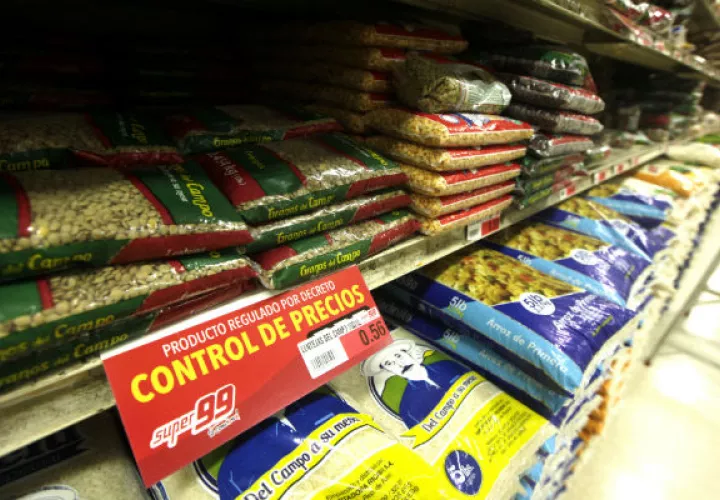
The government has chosen to extend, yet again, it's failing policy of price controls of certain basic foodstuffs. The policy has been seen to affect the whole supply chain from produces right to consumers.
The measure has been blamed for causing price increases across a number of unregulated products, to the detriment of consumers.
Imported lentils are an example of the market distortion the policy has brought around: the price for this staple has gone from $0.56 to $0.70 for per pound. Similarly, the price of yam has gone from $0.35 to $0.40 per pound.
In the case of onions, producers and distributors requested that the regulated price be increased from $0.60 to $0.80 per pound, due to the need of importing the product as a result of scarce national production. It is not unusual for a pound of onions cost as much as $2.60 to the end consumer these days.
Producers have also requested that the price of plum tomatoes be increased to reflect higher production costs, now at $1.00 per account, upping it from $1.08 to as high as $1.50 to $2.00.
Producers are up in arms because they’ve been forced to sell their produce below cost, suffering large losses. For their part, consumers complained that the price control policy has meant that there unable to buy produce at lower cost when production is abundant; and that, additionally, the measure has caused the price of non-regulated products to skyrocket.
According to highland producer Augusto Jimenez, the government is unlikely to repeal the price control policy because of its political commitment to it. Mr. Jimenez complains that he has lost leveraged over produce pricing: when production is abundant, distributors buy at low cost and enjoy margins as high as 50%, by selling at regulated prices.
Another farmer, Maximino Diaz, declared that either this measure is repealed, or farming will risk disappearing in Panama: 'this measure has seriously affected all producers of regulated produce', he denounced.
Mr. Diaz exemplified the problems facing producers of yam, whose regulated price is $0.40 per pound. Producers cannot afford to sell for more than $15.00 to $18.00 per 100 kilos, to allow for some level of profit for retailers. However, farmers face costs as high as $20.00 per 100 kilos. “This measure has to be repealed: this is what both producers and consumers advocate, since it benefits nobody”, he admonished.
Meat is another example of the distorting effects of this failing policy. Unable to find regulated cuts, consumers have seen their himself obliged to buy meat cuts not covered by the price control system, or simply give up eating meat altogether.
Unsurprisingly, unregulated meat cuts have seen their prices skyrocket, as producers attempt to cover losses caused by the controlled prices of regulated meat cuts. The El Niño weather system
has only made matters worse for livestock farmers.
The cost of meat is inversely proportional to the level of culling of national livestock: the latter has fallen 10.2% this year. As a result, the majority of meat cuts today have seen their prize rise by as much as 40% compared to two years ago.
According to the former president of the Panamanian association of livestock farmers (Anagan), Euclides Diaz, the price control policy would result in a $14m fall for the national meat industry this
year.
Rice production
As regards rice, which is also regulated product, state coffers have been seriously affected, since the government has to pay $7.50 to producers in the way of compensation for the below market prices.
Multiple experts have concluded that this is unsustainable.
According to Lorenzo Lenin Galvan, president of the Commission for Agriculture and Fisheries Affairs at the Panamanian Association of Business Leaders (Apede), the price control policy has caused



market distortions across a number of products. Mr. Lenin Galvan considers that persevering with this measure would be counterproductive.
The president of the Panamanian Chamber of Commerce, Industry and Agriculture (CCCIAP), Jorge Garcia Icaza, added his voice to those demanding the withdrawal of the measure, pointing out that one of the primary rationales behind it, high inflation, had fallen by 0.6%. Mr. Icaza believes that a return to market economics would benefit consumers.
According to the president of the Panamanian Union of Industrialists (SIP), extending the measure would affect the level of investment as well as growth across a number of businesses in the country.
Contenido patrocinado




Últimas noticias