Teachers' unions have warned that the budget that the education ministry has destined for repairs across 1200 schools is not adequate to actual needs of the latter.
This is in spite of a gradual increase in the education budget, which would rise to 6% of GDP by 2019.
For fiscal year 2017, the budget will amount to $2.159 billion. However, only not 0.8% of that amount will be destined to school repairs meant to take place before the start of the school year, amounting to a mere $17m. That sum was included in the $201m earmarked for general investments.
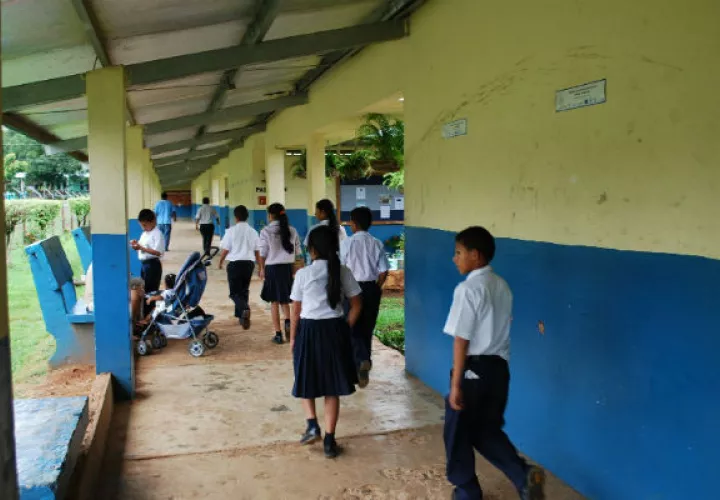
Teacher unions’ representatives have denounced the proposed amounts as risible considering the state of disrepair of most state schools.
Luis Lopez, representative of the National Front of Independent Educators (Frenei), highlighted the generalized concern that the amount that Meduca has earmarked for investments will fall short of actual needs, unless education minister Marcela Paredes were to resort to emergency funding next year.
He estimated that $500m are needed to address infrastructure and maintenance needs at schools across the country.
“Buildings need to be repaired, but schools also need technical equipment and educational materials", he argued, pointing out that, all things considered, the current education budget was
'ridiculously inadequate'.
“Schools in a state of disrepair are concentrated in Panama and Colon", Mr. Lopez explained, adding that 'rural schools also represent a serious issue: we are concerned that the new academic year will once again begin without much needed maintenance being carried out ".
He referred to the case of 'the Ernesto T. Lefevre School, where a building that was supposed to be demolished is still standing, and to many similar examples at many other schools across the country'.
According to teacher union representative Nelva Reyes, almost all schools across the country are in some state or other of disrepair, meaning that the $17m earmarked by Meduca would be allocated to only the most urgent cases. For instance, this would exclude education centers that have suffered from issues with septic tanks as well as other infrastructure failures.
Ms. Reyes argued that it is the responsibility of the regional directors at Meduca to carry out a census of those schools most in need: "without carrying out this exercise, yet another academic year will commence with some schools remaining closed", she intimated.
'While we understand that in many cases schools suffer from years of under investment, we must make an effort to carry out maintenance and repairs where most needed', she insisted. 'This i not going to happen if Meduca has to rely on a single plumber for a whole educational region' she warned, adding that' no plumber wants to work for Meduca when they can earn much more money working for their own account'.
For her part, Aixa Gomez, member of the Federation of Parents, argued that the problem of school maintenance and repairs is rooted in poor administration, over and above limited budgets.
Ms. Gomez explained that "only through constant maintenance can you avoid seriou deterioration of school buildings', adding that "maintenance departments must improve their process of supervision and facilitate repair works when those are called for".
She highlighted a “lack of supervisory personnel as one of the main reasons for constant delays in repair works”, insisting that “even if schools have funding, unless administrative surveys are carried out, no repair works can even begin”.
Ms. Gomez related the paradox of "parents who work in construction and offer to carry ou volunteer repair work, and who are prevented from doing so because of the existing administrative bottleneck: this has to be overcome".
Education minister Marcela Paredes de Vasquez attempted to justify herself by arguing that earmarked investments are commensurate to the needs for new educational centers meant to replace rural schools in indigenous regions.
Nevertheless, she has been criticized for the lack of an adequate budget for school infrastructure repairs. Even members of her own government have recognized serious delays in the execution of construction projects worth less than $350,000.
Indeed, during the presentation of the education budget for fiscal year 2016-2017, the president of the budgetary commission, Jorge Ivan Arrocha, urged minister Paredes to accelerate the execution of construction projects, adding that 'education can no longer wait'.
However, union leader Diogenes Sanchez holds the government responsible for keeping schools in deplorable conditions, and for failing to show adequate interest in the maintenance of their facilities.