
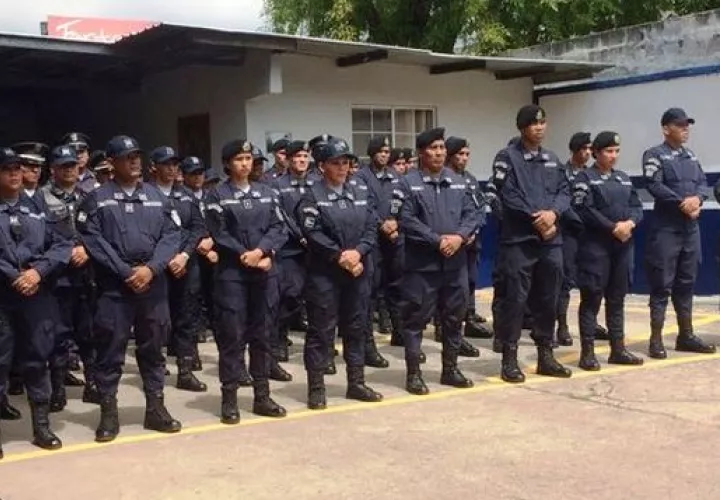
A new class of privileged government officials has taken hold in the government of Juan Carlos Varela. It is made up of career military personnel, who not only occupy high hierarchical positions in the security apparatus of the country, but who also control key sensitive institutions of the state which were previously under civilian management.
The officials in question are responsible for substantial government budgets. For instance, the minister in charge of public security, Alexis Bethancourt, is a military man responsible for $700m, an amount greater than those destined to education and public healthcare.
Similarly, at the ministry for the presidency, a military man, Rolando Lopez, is the head of the executive secretariat for security, a position once occupied by civilian. In his current position, Mr. Lopez has access to large amounts of extremely sensitive information. No official data on the actual size of its budget is publicly available: what is known is that the ministry for the presidency handles approximately $900 million annually.
A return to old practices
According to Miguel Antonio Bernal, a constitutional lawyer who was persecuted and imprisoned during the country’s military dictatorship, the government of President Juan Carlos Varela 'has plunged the country back to the era when a group of military men enjoyed power and privileges'. Mr. Bernal's allegations are supported by public data showing that high-ranking officials in the Varela government enjoy greater salaries than those paid to government ministers.
Such is the case for the executive secretary of Security Council, Mr. Lopez: according to official data, Mr. Lopez receives a salary of $10,000 per month. This is $3,000 higher than the top salary payable to a government minister.
And yet, his exorbitant salary is the lesser of two evils: of greater concern is the high degree of power that has been concentrated in the hands of Mr. Lopez, who is reported to be a very close aide to President Juan Carlos Varela.
And this power concentration only keeps growing. Via a recently issued decree, President Varela has authorized the creation of three institutions that will be directly overseen by the secretariat of the Security Council, and which will be managed by military personnel. According to decree in question, two such institutions were created with the aim of preventing terrorism; the third one consists of a military academy that will train security personnel on matters of intelligence.
Mr. Bernal denounced the creation of these three security bodies as "not compatible with a civic public security policy based on human rights".
According to Jose Raul Mulino, who was security minister during the government of Ricardo Martinelli, the creation of an intelligence academy within the Security Council is redundant, since this type of training is the responsibility of the national police force.
For its part, the current salary of security minister Alexis Bethancourt remains a mystery to this day. Publicly available data on government expenses show that the security ministry payroll has not been updated since last March, when both minister and deputy minister resigned from their positions.
What is known is that Mr. Bethancourt was previously director of the Financial Analysis Unit (UAF).
He is reported to have been appointed to this sensitive position by his boss, Rolando Lopez. Both men worked in the investigative unit (DIP) of the national police force.
While at the UAF, Mr. Bethancourt had access to private bank accounts, allowing him to monitor the financial transactions of any financial entity. It is widely reported that such information was employed by the current administration for the purpose of political persecution against former government officials.
His current replacement, Alejandro Melo Tuñon, is another military man who studied at the Military Academy of Argentina alongside Mr. Bethancourt. According to public data, Mr. Melo Tuñon receives a salary of $6000 per month, comparable to that of a minister of state.
This closely knit circle of military men occupying high-ranking positions in the government of Juan Carlos Varela also extends to the national police force. Such is the case of Omar Pinzon, a close ally of Mr. Lopez, whose salary amounts $8,000 dollars per month. According to a knowledgeable source, 'the two men have been the best of friends since their days in their native Veraguas'.