
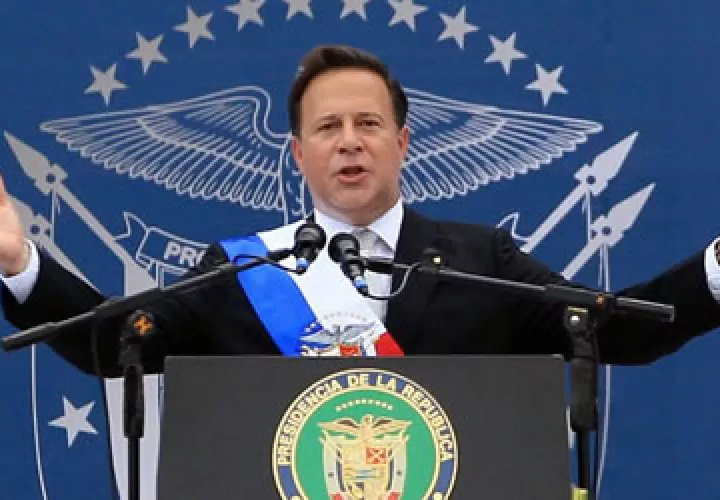
The government of Juan Carlos Varela has been marked by an ever increasing number of corruption scandals, the vast majority of which has gone unchecked by the judiciary.
The number of institutions touched by corruption is considerable: it ranges from the very Ministry for the Presidency, to the Ministry for Government (Mingob), the Institute for Agriculture and Fisheries, the National Assistance Programme (PAN, today DAS), as well as the Housing, Education (Meduca) and Security ministries, among others.
In the face of such wave of scandals, the president of the republic has defended his government record, claiming that all cases were caused by administrative errors that have since been corrected.
Nevertheless, the Public Ministry (PM) has been seen to abide by orders coming straight from the executive, which has on more than one occasion publicly spoken about judicial cases that had not even reached the courts.
The PM has been remiss in taking action in flagrant cases of conflicts of interest, such as that concerning Airco S.A., a company owned by Pedro “Peter” Vallarino, a very close personal friend of President Varela. Airco S.A. has been awarded contracts for the purchase of heavy machinery on behalf of the housing ministry, via the PAN, worth $22m in total. The public complaint made by anti-corruption tsar Angelica Maytin on the manner the contracts were handled, were to no avail.
Like this, no proper investigation has been seen to take place in the case of a network of civil servants that allegedly altered purchase orders in the educations ministry.
An even more high-profile case that has not been scrutinized by the PM is that concerning former ministerial adviser to the presidency, as well as president of the Panameñista party Ramon Fonseca Mora. Mr. Fonseca Mora is the co-founder of disgraced law firm Mossack Fonseca, which was embroiled in a global money-laundering and tax evasion scandal in April.
The cumulative weight of these scandals appears to have begun to weigh on the conscience of more than one ministerial director. Resignations have begun to flow in, as many fear the judicial consequences of such overt acts of corruption once the reign of President Varela is over.
According to Dinoska Montalvo, a Cambio Democratico (CD) party member, “the government of Juan Carlos Varela distinctly stinks of corruption and impropriety: members of the governing team are beginning to see this and are voting with their feet”. Thus far, four ministers have resigned their positions, on top of ten ministerial directors.
According to political veteran Jorge Gamboa Arosemena, either the government takes the necessary corrective measures, “or it will end up in a similar situation as their predecessors”.
So far, the only case that has been fully tried is that of Grimaldo Cordoba, who practices as a doctor without been qualified to do so. The Panameñista party member was condemned to 42 months in jail, commutable.
Bill of law aimed at tackling corruption in public tenders remains stuck in cabinet

The bill of law that aims to eradicate corruption from public tender contracts has remained stuck in cabinet. President Juan Carlos Varela has publicly declared that the law will soon be approved, once some amendments aimed at improving it are sent to the National Assembly.
Nevertheless, the bill does not consider measures aimed at banning companies that have been linked to corruption scandals from bidding in government tenders.
According to the president, “the aim of the bill of law was to make the public tender process more efficient”. The bill of law was preliminary approved in the national assembly on April 29 this year, but won’t be debated again until July 1. In the meantime, the president has failed to live up to his promise to discuss it in cabinet sessions.
Contenido patrocinado




Últimas noticias