


Collection of tax for underground cable project is unconstitutional
- D.Díaz/M.Lasso (economia.pa@epasa.com)
- /
- @PanamaAmerica
The Supreme Court (CSJ) declared unconstitutional the tax collection of 0.5% to finance the underground wiring system in the country, more than three years after...
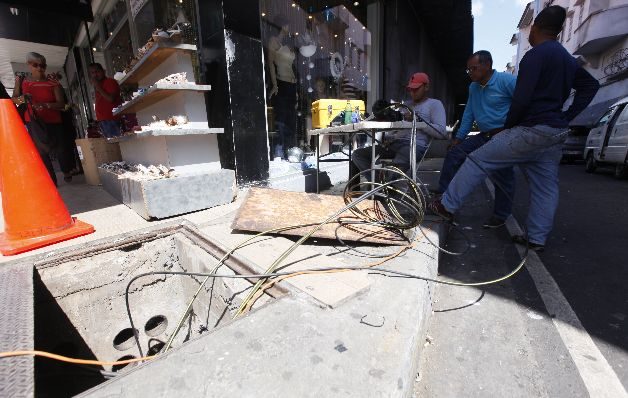
The underground cables project still recorded large arrears, however, the tax to finance it have been charged to the consumers for three years. / Archive
The Supreme Court (CSJ) declared unconstitutional the tax collection of 0.5% to finance the underground wiring system in the country, more than three years after it starts without a great progress.
The Court determined that it "can not impose a tax on all customers, the obligation to pay a sectored service", said the plaintiff's lawyer, Ernesto Cedeno.
This, considering that the Law 15 of April 26, 2012 stated that the rate applied to all customers in the monthly bill of local, national and international basic telecommunication services, personal communications, mobile telephony, telecommunications transport and pay TV.
With the money collected a fund for the management and financing of projects of underground wiring and infrastructure for telecommunications and pay-TV in the country was created.
According to the document, these funds were transferred to a trust subject to the control and supervision of the Office of the Comptroller General of Colombia.
Cedeño said that the charge is imposed in consideration for a service, which did not occur in this case.
He added that after the judgment of the Court shall be the Authority for Public Services (ASEP) send the injunction rate operators and decide on what to do with the payment made by consumers.
Giovanni Fletcher, from the Panamanian Institute of Law of Consumers and Users (Ipadecu), said that the decision of the Court does justice to thousands of consumers who pay for a service not received.
He argues that consumers are being forced to pay the cable burial service that will only be implemented in specific and "privileged" areas of the country.
However, the work covers only a polygon in the Nicanor de Obarrio (Calle 50), Via España, Via Brasil and Federico Boyd Avenue in the capital city. Similarly, in the district of David, Chiriqui, and Santiago de Veraguas.
He said residents in those areas must finance the cost of that project.
Fletcher sees the ruling as a breakthrough, and recognizes the efforts of resource plaintiff, since this tax affected the economy of thousands of consumers, misused, defrayed this service for a small sector.
However, the question of consumer representatives is the destination of the money raised so far and that is in a trust at the National Bank of Panama.
According to Fletcher, it remains for Asep provide the mechanism for returning proceeds through loans to users. In this match also general secretary of the National Union of Consumers and Users of the Republic of Panama (Uncurepa), Pedro Acosta, who argues that the ASEP must find a formula to return the payment made by consumers.
Meanwhile , Cedeno said that the judgments of the Court are not retroactive, so the decision will be left to the ASEP .
However, the ruling dated September 2015 is in the process of notification from Friday January 15, 2016 .
Before the decision of the Supreme Court, it was consulted with the National Authority of Public Services (ASEP), which will have to take the step to be followed, however, reported by the Directorate of Public Relations that not issue any judgment about it until receiving a copy of the ruling.


Para comentar debes registrarte y completar los datos generales.